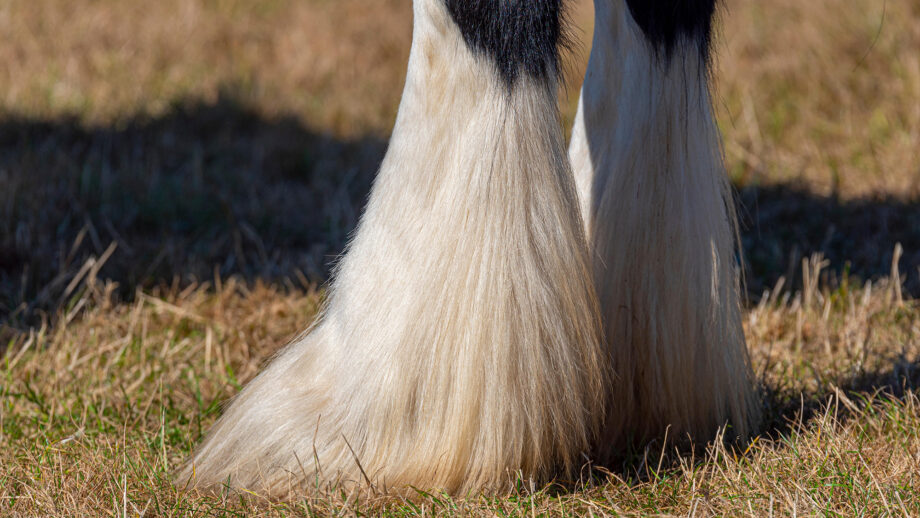

Feather mites in horses are among the most stubborn of equine parasites, causing a condition commonly called heel mange (chorioptic mange). The condition typically affects heavily feathered breeds such as traditional cobs, Shires, Clydesdales and Friesians, and some native ponies.
When severely affected, horses with an infestation will typically stamp their hooves, and bite or rub at the backs of the legs. With time, some cases can develop severe crusting and scaling of the skin on the lower limbs, with skin thickening and general swelling, which can become infected and quite debilitating. As a result it is important to treat and control the condition effectively in the early stages to prevent it worsening.
This common skin condition is typically more of a problem during the winter when horses spend more time stabled and the condition often improves during the summer with increased turn out.
Feather mites in horses: Causes| | Signs | Diagnosis | Treatment
The mites responsible for chorioptic mange
According to Kieran O’Brien MRCVS, theses mites are of the species Chorioptes bovis, not Chorioptes equi as often described: “It is now thought that a true equine mite species does not exist, and consequently that cattle may infect horses and vice versa.”
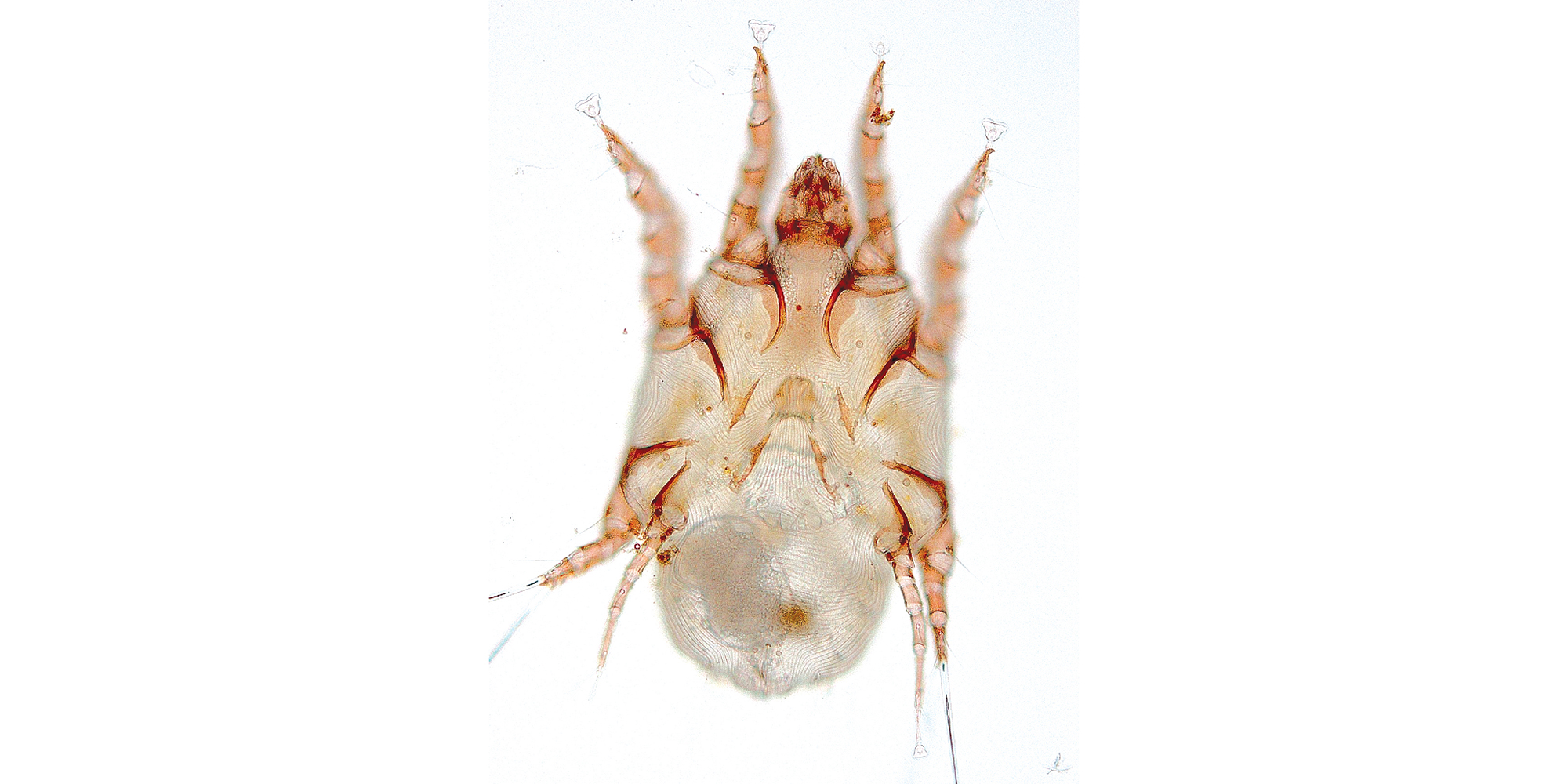
The Chorioptes bovis mite is the guilty party. Credit: Marieke Brys
The mite completes its full life cycle on the horse’s legs and feet within the horse’s feather. Eggs are deposited singly by female mites at the rate of one egg per day and are attached by a sticky substance to the host skin. Adult females usually live for four to six weeks or more, producing about 14–20 eggs during this time.
The eggs are often clustered, as multiple females deposit in common sites and return on successive days to deposit their eggs. The eggs hatch in four days and the cycle is completed in around three weeks.
Mr O’Brien warns that eggs and mites can survive for up to 69 days on bedding, floors and grooming equipment, and as a result, environmental “de-infestation” is an essential part of control.
It has been shown that some horses can harbour large numbers of mites without showing any external signs. A survey of 42 Friesian horses in the Netherlands1 found mites on 26 of them, but only four had visible lesions.
It follows that in yards where there is at least one infested animal, other horses (including possibly those without feather) may well be carrying mites and may act as an ongoing source of infestation. Therefore treatment should also be applied to other horses living in close proximity.
Signs of feather mites in horses
Classic horse behaviour that signals the mites’ presence includes stamping of the hooves, either a single stamp or more commonly several stamps in quick succession. Also biting and rubbing their legs with the opposite hindleg or against fixed objects, for example against buckets or floor-level feeding troughs.
Irritation is usually low down around the pastern and fetlock area, although it will occasionally spread further up towards the back of the knees and hocks. While both front and hindlegs can be affected, the condition is more common in the hindlegs. Frequent stamping behaviour in a feathered breed is highly suggestive of mite infestation.
The mites feeds on superficial scales and debris on the skin surface, without burrowing into or puncturing the skin. The movement and feeding behaviour of the mites causes the lower legs to become itchy and irritated.
If the long hair is parted, scales and crusts will be seen in the pastern, fetlock and cannon regions. Trauma from biting and rubbing the legs will cause reddening and thickening of the skin and matting of the hair. Secondary bacterial infection may occur, with weeping and more significant crust formation. In long-standing cases some “corrugation” of the skin may occur at the back of the pastern.
In severe cases, horses may resent their legs (especially behind) being handled, and both clipping (if done) and any topical treatment may require the horse to be sedated first
Diagnosis
Diagnosis of feather mites in horses is usually based on the presence of the signs. The scabs can look similar to those produced by mud fever or pastern dermatitis, but excessive irritation indicates feather mites. The scabs may sometimes be mistaken for pastern leucocytoclastic vasculitis (PLV) or chronic progressive lymphoedema.
Skin scrapes can be taken, but can be hard to do properly on hairy legs, so mites can be lifted off on a piece of sticky tape to make a definite diagnosis; because these little parasites are too small (0.3-0.5mm long) to be seen with the naked eye, analysis under a microscope is required.
Mr O’Brien also suggests a clean toothbrush can be used to dislodge crusty material from the horse’s feather, which is then collected and examined.
Treatment of feather mites in horses
Some owners are reluctant to clip their horse’s feather, but doing so drastically improves the chances of treatment success.
There are currently no licensed medications for treating Chorioptic mites in equines, but most cases are treated through a combination of topical and systemic options, combined with active decontamination of the horse’s environment.
Mr O’Brien recommends shampooing the horse’s legs the afternoon before any topical treatment so the legs can dry overnight and any topical treatment applied the following morning. Topical treatments should be applied up to above the knees and hocks.
A mild antiseptic wash (such as a tea tree shampoo) should be used to help remove any serum or scabs and reduce the skin scurf. Your vet may need to sedate the horse for this procedure, as the legs are likely to be very sore.
Options for topical treatments include:
● selenium sulphide shampoo, such as Selsun (use neat) or Head & Shoulders Clinical Strength (diluted to 50% with water), applied and left in contact for 10 minutes before rinsing. Repeat on days five and 10. Ideally a “whole horse” treatment should be done once also.
● lime sulphur 5% diluted as instructed and applied without rinsing four times at weekly intervals.
● ivermectin, moxidectin or doramectin (doramectin can also be given by injection).
Licensed for the treatment of worms in horses, Mr O’Brien warns that the current emerging resistance to these medications indicates that we should avoid using them for mite treatment unless there are no alternative approaches.
He says: “Moxidectin, for example, is currently the only effective treatment for larval redworm diarrhoea – an often fatal condition – and this medication should therefore be used for mite treatment only in exceptional circumstances.”
● fipronil dog and cat flea treatment (such as Frontline Plus).
Mr O’Brien says: “Although it may be effective, the large dose required and the significant and persistent environmental effects of this compound (especially if it contaminates water sources), means that I discourage its use for sustainability reasons, and where there are other effective remedies.”
Decontaminating the horse’s environment
Because both the mites and their eggs can survive for up to 10 weeks off the horse, environmental decontamination is also important when treating feather mites in horses. Stables should be emptied of bedding and steam-cleaned, along with grooming equipment, clippers and rugs. Pay particular attention to disposing of any clipped hair and skin debris, as this will be heavily infested with mites.
Any animals in direct contact with those affected should also be treated to help avoid recontamination, but it is rarely feasible to treat every horse in a yard.
Sustained treatment of all individuals beyond the three-week mite life cycle, followed by quarantine measures and/or repeated preventative treatment prior to exposure of an untreated horse is often curative. Unfortunately, susceptible horses seem to easily become re-infected so ongoing management is often required.
References
1. Netherlands – Cremers – The Veterinary Quarterly 7:283 – 1985
Comparative study of doramectin and fipronil in the treatment of equine chorioptic mange – September 2007
Oral ivermectin paste for the treatment of chorioptic mange in horses – Dec 1995
Vet Clinic – Feather foes, published in Horse & Hound magazine – 22 January 2026
- For unlimited access to advice on how best to care for your horse, subscribe to the Horse & Hound website
You may also be interested in…

Struggling with mud fever? Here’s what you need to know to tackle it…

Lymphangitis in horses: what you need to know

Equine ringworm: what all horse owners need to know

Sweet itch in horses: what all horse owners need to know

Thrush in the horse’s hoof: a smelly problem that needs addressing

14 medicated shampoos and washes to soothe the skin and clean the coat

Subscribe to Horse & Hound magazine today – and enjoy unlimited website access all year round